

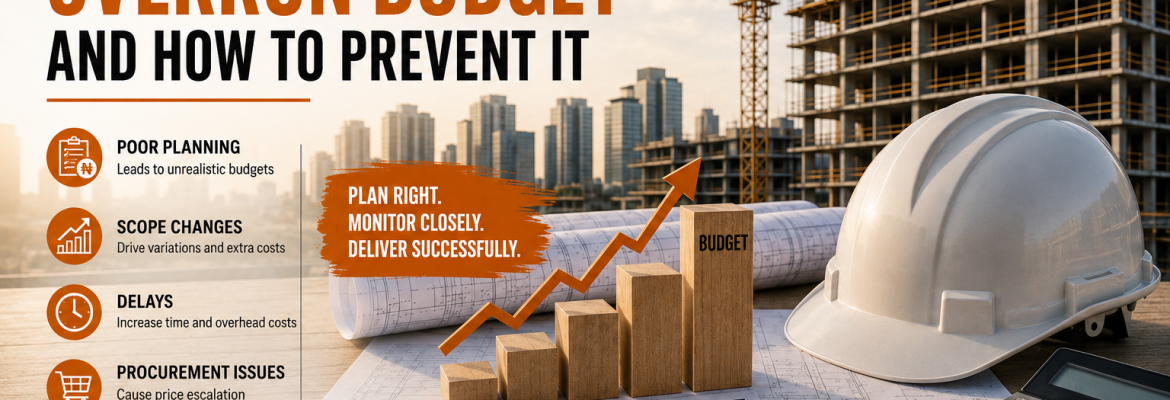
In Nigeria’s construction industry, budget overruns have become so common that many developers now almost expect them before a project even starts. A project begins with a projected cost of ₦500 million, only to finish at ₦700 million or more. In some cases, projects are abandoned halfway because the financial structure collapses under rising costs and poor planning decisions.
The problem is that budget overruns are often discussed too generally, as though they are caused by “economic conditions” alone. While inflation and market instability certainly play a role, the reality is more complex. Most projects exceed budget because of a combination of poor planning, unrealistic assumptions, weak project controls, delayed decision-making, and an inability to adapt to Nigeria’s operating realities.
Construction today is no longer taking place in a stable environment. Material prices fluctuate aggressively, foreign exchange rates shift unpredictably, approval timelines can extend unexpectedly, and infrastructure limitations continue to affect logistics and execution. Yet despite these realities, many projects are still planned using assumptions that belong to a more predictable market.
The result is financial instability from the very beginning.
Unrealistic Cost Planning Is Still a Major Problem
One of the biggest causes of budget overruns in Nigeria is unrealistic budgeting at the planning stage.
In many projects, the initial budget is prepared based on what the client hopes to spend rather than what the market is actually saying. Some developers intentionally reduce projected figures to make projects appear financially attractive to investors or financiers. Others rely on outdated rates that no longer reflect current market conditions.
This becomes dangerous in an economy where prices change rapidly.
Take reinforcement steel, for example. In Nigeria, steel prices can rise significantly within a few months due to exchange rate movements, import costs, fuel prices, and transportation expenses. The same applies to cement, aluminum, electrical fittings, generators, elevators, and finishing materials.
A budget prepared in January may already be inaccurate by April if procurement has not been properly secured.
This is why many projects that initially appear financially stable eventually struggle during execution. The project was under-budgeted from the start.
Foreign Exchange Volatility Is Reshaping Construction Costs
Nigeria’s dependence on imported construction materials and equipment continues to expose projects to exchange rate risks.
Many developers still specify imported finishing materials, HVAC systems, elevators, lighting systems, and specialized equipment without fully understanding how foreign exchange fluctuations will affect final project cost.
A project priced when the exchange rate was relatively stable can quickly become financially distressed after currency depreciation.
This is especially common in:
- High-rise residential developments
- Commercial office projects
- Luxury apartments
- Hospitality developments
- Industrial facilities
In Lagos and Abuja particularly, many premium projects have experienced budget escalation because imported components became significantly more expensive during execution.
Unfortunately, many developers only begin to react after the cost increase has already affected procurement.
Poor Scope Definition Creates Expensive Variations
Another major issue within local projects is the tendency to commence construction before designs are fully coordinated.
In some cases, clients are eager to start site work immediately after conceptual drawings are completed, believing unresolved details can be addressed during execution. This creates constant variation orders once construction progresses.
A staircase changes position halfway through execution. The façade specification changes after procurement begins. Mechanical systems are redesigned because space allocation was inadequate. Structural revisions emerge after excavation.
Every one of these adjustments affects cost.
Variation is not always a sign of project complexity. Sometimes, it is simply evidence that important decisions were postponed too late.
Many Nigerian projects are still operating with fragmented consultant coordination, where architects, engineers, and contractors are not fully aligned before site mobilization. The financial consequences usually appear during execution.
Delayed Client Decisions Are Increasing Costs
This is one of the least discussed but most damaging causes of overruns.
Projects slow down significantly when clients delay approvals, payment decisions, material selections, or consultant instructions. Contractors remain on site, labour costs continue accumulating, equipment remains idle, and timelines extend.
In today’s market, delays are extremely expensive because inflation continues moving while the project remains active.
A project delayed by three or four months in Nigeria can experience major cost escalation purely because material prices have changed during that period.
Delayed decisions are no longer administrative inconveniences. They are financial risks.
Procurement Challenges and Supply Chain Pressure
Procurement has become one of the most sensitive areas of construction management in Nigeria.
Import restrictions, port congestion, diesel costs, transportation challenges, insecurity along logistics routes, and unstable supplier pricing all affect project delivery.
Some contractors still use reactive procurement systems, purchasing materials only when urgently needed on site. This approach is increasingly risky in an unstable market.
Projects that fail to plan procurement strategically often face:
- Material shortages
- Emergency purchasing at inflated prices
- Delivery delays
- Quality compromises
- Inconsistent pricing
For example, developers in Port Harcourt and Abuja have experienced project delays because imported finishing materials remained stuck at ports longer than expected, affecting installation schedules and contractor claims.
Procurement is no longer just about buying materials. It is now a major component of risk management.
Weak Contractor Capacity
Another local reality is that some projects are awarded based primarily on the lowest tender price rather than actual delivery capacity.
A contractor may submit an attractive figure to secure the project, only to later discover that the pricing was unrealistic. Once execution begins, the contractor struggles with cash flow, labour retention, procurement, and delivery.
The project then becomes unstable.
This often leads to:
- Repeated requests for variation claims
- Poor quality execution
- Delayed delivery
- Contractor abandonment
- Disputes between stakeholders
The cheapest contractor is not always the most economical option in the long run.
Regulatory Delays Also Affect Cost
Approvals and regulatory processes continue to affect project budgets significantly, especially in Lagos and Abuja.
Delays in planning permits, environmental approvals, utility clearances, and development permits can extend mobilization timelines and expose projects to inflation before execution even gains momentum.
A project waiting for approval is still losing money through consultant costs, financing exposure, and delayed investment returns.
This is why regulatory planning must be integrated into project scheduling and financial forecasting from the beginning.
How Budget Overruns Can Be Prevented
Preventing overruns requires discipline, not optimism.
Projects that maintain financial stability usually share several characteristics:
- Realistic cost planning based on current market realities
- Strong feasibility analysis
- Proper design coordination before construction starts
- Structured procurement planning
- Continuous cost monitoring and forecasting
- Early risk identification
- Clear decision-making processes
- Competent contractor selection
Most importantly, successful projects treat cost management as an active process, not a document prepared once at the beginning.
Conclusion: Financial Control Begins with Strategic Planning
Budget overruns are not simply caused by inflation or economic instability. In many cases, they are the result of weak planning structures, delayed decisions, unrealistic assumptions, and poor project coordination.
In Nigeria’s current construction environment, successful project delivery requires far more than technical execution alone. It requires proactive cost management, structured procurement strategies, disciplined project controls, and a deep understanding of how local realities influence project performance.
At Samprec Consultants Ltd, we understand that cost certainty is one of the most important foundations of successful project delivery. Our approach focuses on realistic planning, continuous cost monitoring, strategic forecasting, and proactive risk management to ensure that projects remain financially controlled from inception to completion.
As construction becomes more complex and market conditions become more volatile, the projects that succeed will not necessarily be the biggest or fastest. They will be the ones managed with the highest level of structure, foresight, and financial discipline.
One Reply to “WHY MANY PROJECTS OVERRUN BUDGET AND HOW TO PREVENT IT”
Thank you for this piece. Indeed lack of proper coordination of the project and poor procurement method are also major factors of exceeding project budget. Like you said, when procurement type is unknown, the responsibility of risk can’t be properly known and enforced