

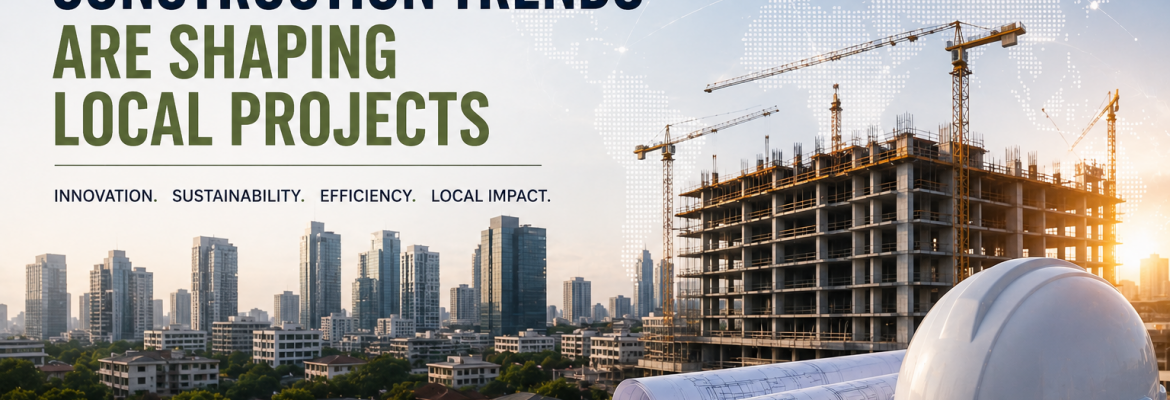
HOW GLOBAL CONSTRUCTION TRENDS ARE SHAPING LOCAL PROJECTS
Construction is no longer a purely local industry. A decision made in Europe on sustainability standards, a technological innovation introduced in Asia, or a supply chain disruption in the Middle East can now influence how projects are designed, priced, managed, and delivered in Nigeria.
This shift is becoming increasingly visible across local construction projects. Developers are asking for greener buildings. Clients are demanding faster delivery timelines. Digital project management tools are replacing manual coordination systems. Investors are becoming more conscious of lifecycle cost rather than just initial construction cost.
In many ways, Nigeria’s construction industry is being reshaped by global trends whether local stakeholders are fully prepared for them or not.
The interesting part, however, is that these global influences do not simply transfer directly into the Nigerian market. They interact with local realities such as inflation, infrastructure deficits, unstable exchange rates, regulatory bottlenecks, skilled labour gaps, and inconsistent material supply chains. This creates a unique construction environment where international standards meet local challenges.
The question is no longer whether global trends will influence local projects. They already are. The real issue is how effectively local project teams can adapt these trends to fit Nigeria’s realities.
The Push Toward Sustainable Construction
Globally, sustainability has moved from being a branding concept to becoming a major project requirement. Developers and investors increasingly prioritize energy efficiency, environmental responsibility, and long-term operational savings.
This trend is gradually influencing Nigerian projects, especially in Lagos and Abuja, where premium commercial developments now incorporate features such as energy-efficient lighting, smart ventilation systems, solar integration, water recycling systems, and environmentally conscious building materials.
But the local reality is more complex.
In many Nigerian projects, sustainability still struggles against cost pressure. Developers often want green features, but not the additional upfront expenditure that sometimes comes with them. The challenge becomes balancing long-term operational value with short-term construction realities.
Yet, the pressure is growing. International investors, multinational tenants, and institutional clients increasingly expect sustainability considerations in project delivery. Over time, this expectation will likely become standard rather than optional.
Technology Is Reshaping Project Delivery
One of the biggest global shifts in construction is digital transformation.
Building Information Modelling (BIM), cloud-based collaboration systems, drone surveying, AI-driven scheduling tools, and digital cost management platforms are transforming how projects are managed internationally. These technologies improve coordination, reduce errors, and enhance decision-making.
Nigeria is gradually adopting these systems, though at varying levels.
Large-scale developments in Lagos, Abuja, and Port Harcourt are beginning to integrate digital project management systems, especially where international consultants or foreign investors are involved. Contractors are also increasingly using drones for site monitoring and progress reporting.
However, adoption remains uneven.
Many projects still rely heavily on manual reporting, fragmented communication, and reactive planning systems. In some cases, technology is introduced without the organizational structure required to support it, creating inefficiencies instead of improvements.
Technology alone does not solve project problems. The real value comes from how well teams integrate technology into project controls, coordination, and decision-making.
Faster Delivery Expectations Are Changing Construction Planning
Globally, project timelines are shrinking. Investors want quicker returns, clients want faster occupancy, and competitive markets reward speed.
This pressure is now affecting local projects as well.
Developers in Nigeria increasingly expect aggressive delivery schedules, especially in residential, commercial, and mixed-use developments. The market is becoming less tolerant of prolonged project durations.
As a result, contractors and consultants are being pushed toward:
- Faster procurement systems
- Better scheduling practices
- Improved coordination between trades
- Off-site and modular construction methods in some cases
But here lies the local contradiction.
While global trends demand speed, local realities often create delays. Material price fluctuations, foreign exchange instability, approval bottlenecks, power supply challenges, and logistics issues continue to affect execution timelines.
This means project planning in Nigeria now requires more than technical scheduling—it requires risk anticipation and adaptability.
Supply Chain Instability and Material Costs
The global construction industry has experienced significant supply chain disruptions over the past few years, and Nigeria has not been insulated from the impact.
Imported materials, equipment, and finishing products have become more expensive due to inflation, shipping costs, and exchange rate volatility. This has directly affected local project costs and procurement strategies.
Many developers who originally depended heavily on imported materials are now exploring local alternatives. This shift is not always driven by preference—it is often driven by survival.
The result is a growing emphasis on:
- Local sourcing
- Material substitution strategies
- Procurement planning
- Cost forecasting and escalation management
In today’s market, poor procurement planning can destabilize an entire project.
Safety and Compliance Standards Are Becoming More Important
Globally, construction safety standards continue to tighten, and this is gradually influencing local expectations.
High-profile building collapses and structural failures in Nigeria have intensified scrutiny around compliance, quality control, and professional accountability. Regulatory agencies are paying closer attention to approvals, structural integrity, and construction supervision.
Clients are also becoming more aware of the reputational and financial risks associated with poor compliance.
This means local projects are increasingly expected to align with stronger quality assurance and risk management practices.
Construction is becoming less tolerant of shortcuts.
The Rise of Data-Driven Decision Making
Globally, construction decisions are becoming more data-driven. Investors now expect detailed feasibility studies, lifecycle costing, risk assessments, and measurable performance indicators before committing capital.
This trend is beginning to reshape local project planning as well.
Developers are becoming more conscious of:
- Project viability analysis
- Cost predictability
- Cash flow planning
- Market demand alignment
- Long-term asset performance
The era of loosely structured construction projects is gradually fading. Investors want visibility, structure, and measurable control.
Local Adaptation Is the Real Competitive Advantage
Perhaps the most important lesson from global construction trends is this: copying international practices without adapting them to local realities rarely works.
Nigeria’s construction environment has unique pressures. Power instability, infrastructure gaps, inflation volatility, regulatory inconsistencies, and procurement challenges all influence project delivery differently than in more stable markets.
The firms that succeed are not necessarily the ones that imitate global systems blindly. They are the ones that understand how to adapt international best practices to local operating conditions.
That balance is where true project efficiency is created.
Conclusion: Building Locally with Global Awareness
Global construction trends are no longer distant industry conversations. They are actively influencing how local projects are conceived, financed, designed, and delivered across Nigeria.
From sustainability and technology adoption to faster delivery expectations and stricter compliance standards, the construction industry is evolving rapidly. But successful project delivery still depends on understanding local realities just as much as global direction.
At Samprec Consultants Ltd, we recognize that modern construction requires more than technical execution alone. It demands strategic planning, disciplined cost management, risk awareness, and the ability to align global best practices with practical local conditions. Our approach is built around helping clients navigate this evolving environment with clarity, structure, and confidence.
As the industry continues to change, the future will belong to project teams that can think globally, adapt locally, and execute intelligently.
Top of Form
Bottom of Form