

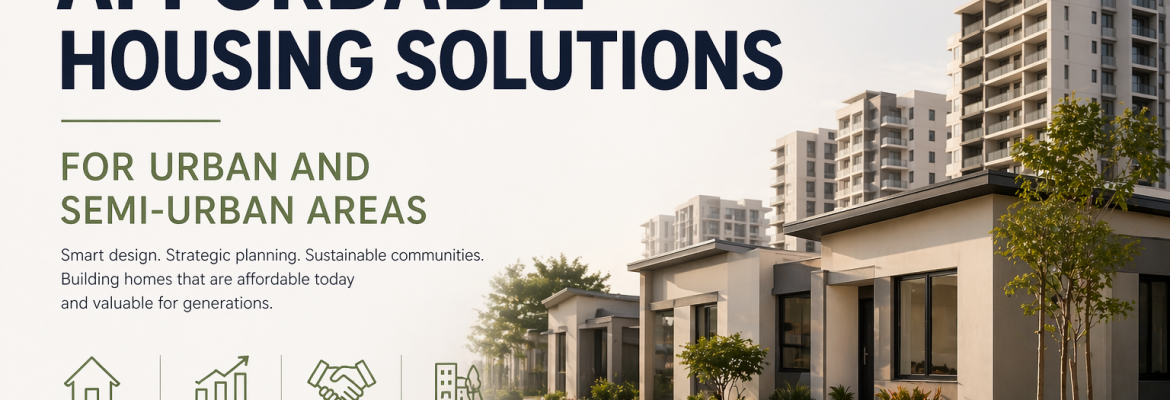
Walk through any fast-growing city in Nigeria and one reality becomes impossible to ignore. Housing demand is rising faster than supply, and affordability is becoming increasingly elusive. Yet, the challenge is not just about building more houses. It is about building the right kind of houses in the right locations, at a cost that aligns with the financial realities of the people who need them most.
Affordable housing is often discussed in broad terms, but when you begin to break it down, the issue becomes more complex. Urban and semi-urban areas present entirely different dynamics. They come with different land values, infrastructure availability, income levels, and development risks. Treating them the same is one of the reasons many housing initiatives struggle to deliver meaningful impact.
Understanding the Real Problem: Affordability vs. Accessibility
There is a tendency to equate affordable housing with low-cost construction. That is only part of the equation. A house may be relatively cheap to build, but if it is located far from economic centers, lacks basic infrastructure, or comes with high financing costs, it quickly becomes unaffordable in practice.
In urban areas, the biggest cost drivers are land prices, regulatory bottlenecks, and infrastructure deficits. In semi-urban areas, while land may be cheaper, the absence of supporting infrastructure such as roads, power, water, and drainage often shifts the cost burden back to the developer or eventual homeowner.
This creates a paradox. Urban housing is expensive because of land and density pressures, while semi-urban housing becomes expensive because of infrastructure gaps.
Rethinking Design: Building Smarter, Not Just Cheaper
One of the most effective ways to address affordability is through intelligent design. This does not mean compromising quality. It means optimizing space, materials, and construction methods.
Compact layouts can reduce wasted space without sacrificing functionality. Incremental housing models allow homeowners to expand over time as their financial capacity improves. Standardization and modular construction help reduce time and cost variability.
Developers who embrace design efficiency are often able to deliver more units at a lower cost per square meter without eroding value. However, design innovation alone is not enough. It must be supported by realistic cost planning and execution discipline, which is where many projects struggle.
The Role of Alternative Building Materials
Traditional construction materials, particularly cement and steel, have seen significant price volatility in Nigeria. This directly impacts affordability and project feasibility.
Exploring alternative materials such as stabilized earth blocks, precast systems, and locally sourced inputs can help reduce costs. The challenge, however, lies in perception and standardization. Many buyers still equate affordability with compromise, and developers are often cautious about deviating from conventional methods.
The solution lies in balancing innovation with trust, ensuring that alternative materials meet performance standards while gradually building market acceptance.
Financing: The Missing Link in Affordable Housing
Even when housing is delivered at a relatively lower cost, financing remains a major barrier. High interest rates, limited mortgage penetration, and short repayment tenures make homeownership difficult for a large segment of the population.
Affordable housing solutions must therefore integrate financing strategies such as cooperative housing schemes, rent-to-own models, public and private financing partnerships, and long-term mortgage structures with manageable interest rates.
Without addressing financing, affordability remains theoretical rather than practical.
Urban vs. Semi-Urban Strategy: One Size Does Not Fit All
Urban housing strategies must focus on density and vertical development. Land is scarce and expensive, making high-rise or mid-rise developments more viable. The emphasis should be on maximizing land use efficiency while ensuring infrastructure can support increased population density.
Semi-urban areas present an opportunity for planned expansion. With lower land costs, developers can create integrated communities, but only if infrastructure is planned upfront. The absence of this often leads to poorly coordinated developments that fail to deliver long-term value.
A critical question developers must ask is whether they are building where people can live or where they can actually thrive.
Government Policy and Private Sector Alignment
Affordable housing cannot be solved by the private sector alone. Government policies play a crucial role in land allocation, titling processes, infrastructure provision, incentives for developers, and regulatory efficiency.
However, policy without execution creates little impact. There must be alignment between government intentions and private sector capabilities.
Public and private partnerships offer a practical pathway, but they must be structured transparently and realistically to attract sustained investment.
Execution: Where Many Housing Projects Fail
Even with the right concept, many affordable housing projects struggle at the execution stage. Cost overruns, delays, poor planning, and weak project controls can quickly erode affordability.
This is where discipline becomes critical. Accurate cost planning from the outset, realistic scheduling and phasing, strong procurement strategies, and continuous cost monitoring are essential to success.
Affordable housing is highly sensitive to inefficiencies. Small deviations can have significant financial implications.
Conclusion: Delivering Housing That Truly Works
Affordable housing in urban and semi-urban areas is not just about reducing cost. It is about aligning design, location, infrastructure, financing, and execution into a coherent strategy. The real challenge is not simply to build houses, but to deliver environments that are functional, accessible, and economically sustainable.
At Samprec Consultants Ltd, we approach affordable housing with this broader perspective. We understand that every decision, from design optimization to cost planning and project control, directly impacts the final affordability of a development. By applying structured cost management, realistic planning frameworks, and disciplined execution strategies, we ensure that housing projects are not only viable on paper but successful in delivery.
As demand continues to rise, the focus must shift from quantity to quality of delivery. Because in the end, affordable housing is not defined by how cheaply it is built, but by how effectively it serves the people it is meant for.